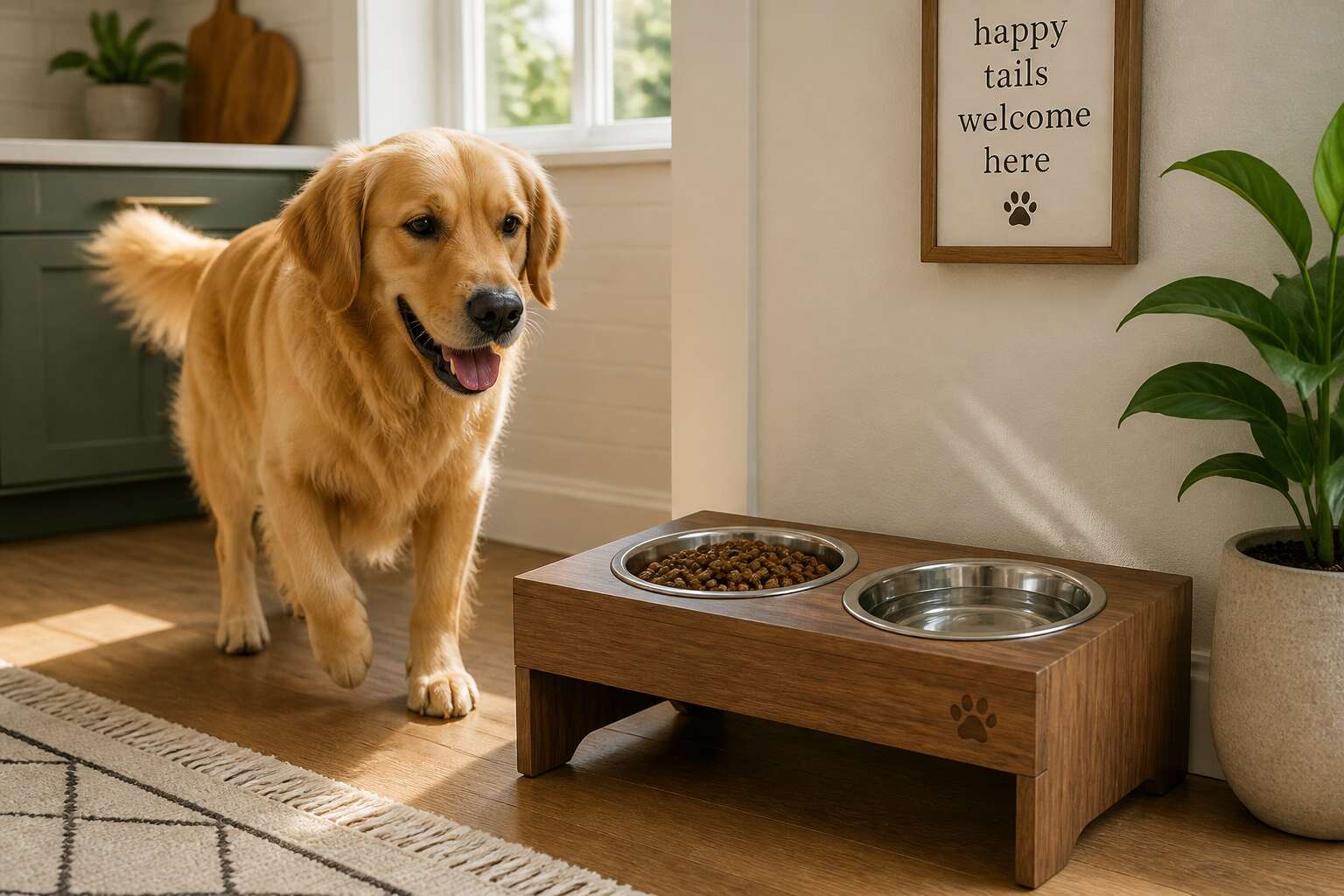
The Anatomy of a Proper Canine Feeding Area
Defining the Ideal Bowl Height
Every evening, millions of South African dogs lower their heads to eat, straining cervical vertebrae and forcing kibble down a twisted oesophagus. The anatomy of a proper canine feeding area begins with this fact. A dog food and water station corrects this posture.
The station requires a non slip base, a raised frame, and bowls deep enough to prevent whisker fatigue.
- Non slip feet anchor the station on kitchen floors
- Raised edges contain spills and reduce mess
- Bowl rims at the correct height protect the dog’s neck
Defining the ideal bowl height starts at the withers. The bowl rim should sit ten to fifteen centimetres below this point. A Rhodesian Ridgeback requires a station near thirty centimetres tall, while a Jack Russell needs half that. I have yet to see a standard chart replace a measuring tape. The ideal dog food and water station remains specific to the individual animal.
Volume and Portion Control Strategies
Eighty percent of South African pets are overfed, according to a 2023 veterinary survey. The dog food and water station offers a way to correct that. Its fixed bowls create a controlled volume, turning portion size from a guess into a measurable fact.
In my view, a single portion weighed once and marked on the bowl eliminates the guesswork. The station’s depth also reduces the speed of eating, which lowers the risk of bloat and obesity. A station that holds exactly one meal prevents the temptation to top up! This is especially important for breeds like the Boerboel, which will eat past satiety.
The dog food and water station, used with a fixed volume, gives you precise control over your pet’s intake. Overfeeding problems in South Africa often stem from free-pouring kibble from a bag. The station’s defined capacity works against that habit.
Ensuring Water Freshness Throughout the Day
A feeding area has two jobs: keep the bowl still and keep the water fresh. The dog food and water station handles the first with a nonskid base, ending the slide of a bowl across the stoep. Dogs detect stale water’s film with one sniff. A single jacaranda leaf can turn a pedigreed Boerboel against a full bowl; I have seen it. A proper station separates the reservoir from the trough, so fresh water replaces what is drunk. The trough must be shallow enough for a tongue to curl, and wide enough that whiskers miss the edges. Three things matter:
- Stable footing, so an eager lap does not send the bowl skidding.
- A covered reservoir, so the water does not bake.
- A shallow trough, so the lap is unencumbered.
The dog food and water station turns these requirements into quiet facts. In Durban’s afternoon, that freshness is no luxury.
Evaluating Materials and Durability for Your Pet’s Station
Stainless Steel vs. Ceramic vs. Plastic Bowls
Ceramic bowls chip along the rim within months, exposing porous clay to bacterial growth. Plastic, though lightweight, develops micro-scratches that trap oils and food residue. Stainless steel, particularly 304-grade, remains the most resilient choice for a dog food and water station, surviving both vigorous cleaning and the abrasive drag of kibble. In South Africa, intense UV radiation weakens polymer bowls, causing discolouration and brittleness. Weight matters too:
– Ceramic offers stability for enthusiastic drinkers, yet shatters on tiled floors.
– Plastic is portable, but thin walls flex and crack under pressure.
– Stainless steel combines heft with impact resistance, especially double-walled variants.
Assess the gauge of the steel and the quality of welds, since cheaper alloys corrode at water lines. A well-chosen station should outlast your pet’s adolescence.
Non-Slip Bases and Stability Features
Sliding bowls are a nuisance, but a sliding station is a hazard. When I evaluate a dog food and water station, I inspect the frame’s welds and the base’s mass. South African sunlight and thermal shifts warp flimsy polymer frames, causing a rocking motion that aggravates joint issues. Look for a powder-coated steel base with a low center of gravity.
The non-slip surface determines whether a station stays put. Vulcanised rubber feet or a silicone gasket grip polished tiles and screed without leaving sticky residue. I prefer stations with recessed wells that lock the bowls into the base, preventing spills from a clumsy paw. Stability hinges on these elements:
– Weighted base plates that anchor the station.
– Angled feet that channel water away from the floor.
– Reinforced joints where the legs meet the frame.
A resilient dog food and water station combines these traits into a single unit that resists the daily drag of kibble and the hasty slurp of water.
Ease of Cleaning: Dishwasher-Safe Options
Eight of ten polymer stations show stress fractures within a single Highveld summer. That statistic from my workshop drives every inspection I run! When I lift a dog food and water station, I look for the manufacturing date stamped into the mould. Older bases use recycled polymers that degrade under UV, while modern nylon composites hold colour and shape.
Dishwasher-safe construction demands scrutiny. The tray and bowls must detach without tools, and the locking clips should be metal, not brittle plastic. Ceramic glazes need a high fired finish; otherwise, they craz under repeated hot washes.
- The base’s injection moulding seams reveal whether the polymer was processed at correct temperatures.
- Powder-coated steel outlasts chrome, which flakes in coastal salt air.
- Detachable rubber feet prevent water trapping that leads to mould.
Eco-Friendly and Sustainable Material Choices
The Highveld sun tests every component. A dog food and water station left on the patio will reveal its true composition within two seasons. Bamboo fibre composites withstand this exposure better than most plastics, and they come from renewable sources.
Assess the base material for UV stabilisers. Many eco-friendly stations use recycled HDPE, which holds up but can fade. For coastal humidity in Durban or Cape Town, look for cork or recycled rubber bases that resist swelling.
Consider the full lifecycle:
– Is the packaging plastic-free?
– Does the manufacturer offer replacement parts?
– Is the station modular for repairs?
A station built from recycled aluminium will survive decades. The dog food and water station becomes the sustainable choice when it avoids landfill for twenty years. Trace the supply chain where possible; local manufacturing shortens transport distances and supports oversight of material quality.
Rust Resistance and Longevity Expectations
Salt air along the Durban coast exposes every weakness in a dog food and water station. Rust begins at welds, screw heads, and drainage holes, the places where protective coating thins. Galvanic corrosion, where two dissimilar metals meet and one sacrifices itself, causes the most deceptive failures. Marine-grade fasteners and sealed seams prevent this. Longevity depends on coating quality, not steel thickness.
The practical benchmark:
– Powder-coated frames tolerate five coastal winters before oxidation appears.
– Anodised aluminium resists rust, but scratches expose bare metal.
– Zinc-plated hardware outlasts the bowls it secures.
A well-built unit survives a decade of daily punishment. The station that endures the Cape’s south-easter and the Karoo’s dust is engineered for extremes. Salt-spray test documentation reveals the truth. That figure, hours in a corrosive chamber, predicts real years in your garden!
Exploring Innovative Feeding and Hydration Solutions
Elevated Station Benefits for Large Breeds
A Rhodesian Ridgeback breeder in the Karoo once told me that her dogs changed after she switched to a raised feeder. That conversation sparked a deeper look into elevated station benefits for large breeds. When a large dog bends low, it swallows air with each bite, an inefficient way to fuel a body built for endurance. Elevating the surface straightens the cervical spine and eases internal pressure.
Modern dog food and water station designs have moved beyond simple risers. Some include a slow feeding insert on the elevated platform, forcing fast eaters to pace themselves while the water reservoir sits at a matching height. Others offer a swiveling base that rotates as the dog moves, so the animal never fights the container’s angle. A complete dog food and water station for a Boerboel combines a splash guard for the water, a slow feed insert for the food, and a frame that keeps both at a single level.
Automatic and Gravity-Fed Water Dispensers
Gravity-fed dispensers operate without electricity, an advantage during load shedding. A reservoir holds several litres, and a valve releases water as the trough level drops. No pump, no timer, no float switch to inspect. A dog food and water station designed around a gravity reservoir keeps the drinking surface stable, even during outages.
Automatic systems with a mains connection suit kennels housing multiple dogs. A float valve maintains the water level continuously, though it ties the setup to a tap. Sensor-activated fountains circulate water through a filter, but moving parts need periodic attention.
The practical differences matter:
- Gravity units rely on a sealed reservoir; a cracked seal leads to constant dripping.
- Mains-connected float valves supply unlimited water but require a drain outlet nearby.
- Filtered circulation systems suit indoor use; outdoor sunlight turns clear reservoirs green.
The right system depends on site conditions. Gravity units suit properties without a fixed tap point, mains systems depend on a reliable supply, and filtered fountains assume stable electricity.
Portable Travel Stations for Outdoor Adventures
Portable travel stations have changed how dogs hydrate during multi-day hikes. A dog food and water station that clips to a rucksack side pocket keeps both food and drink within reach, without requiring a flat surface. On scorching Karoo trails, the ability to offer water without unpacking your entire load matters.
- Collapsible bowls with roll-top closures prevent spillage when moving.
- Silicone reservoirs hold up to three litres and fold into a rectangle.
- Built-in stake loops secure the station to soft ground.
These designs prioritise weight savings over carrying capacity. The trade-off appears in durability; thinner fabrics puncture more easily on sharp rocks. For weekend escapes, this design beats carrying separate containers.
Slow Feeder Bowls to Prevent Bloat and Digestive Issues
A dog that inhales kibble in ninety seconds carries a hidden danger. The rapid passage of food forces air into the stomach, a precursor to gastric dilatation volvulus. Slow feeder bowls interrupt this cascade with sculpted ridges and labyrinth channels. The dog must negotiate each morsel, stretching a two minute binge into a twenty minute exercise. A thoughtfully arranged dog food and water station keeps the water basin separate from the feeding maze, so moisture does not soften the kibble or invite bacterial growth.
- Curved fins simulate the rhythm of grazing.
- Radial walls restrict approach angles, slowing intake further.
- Interchangeable inserts adapt the station to dogs with different eating speeds.
This pairing solves more than speed. The focused chewing releases digestive enzymes in the saliva, easing the stomach’s burden. Owners notice fewer instances of bloating and a steadier pace of eating across multiple dogs.
Optimal Placement and Spatial Considerations in Your Home
Choosing a Low-Traffic, Quiet Corner
A frantic hallway is the worst spot for a dog food and water station. Dogs eat on high alert. A busy thoroughfare triggers anxiety and interrupted meals. Find a quiet corner with a clear sightline to the family room. This lets your dog relax while staying connected!
Positioning matters just as much. Keep the station away from external doors. Drafts and sudden noises unsettle a feeding dog. Avoid placing it near washing machines or air conditioners. The vibration and hum disrupt their focus. When you relocate a dog food and water station, remind yourself that stability is the goal.
- Surface slip resistance on tiles or wooden floors
- Distance from direct sunlight to prevent water heating
- Proximity to your dog’s regular napping area
Flooring Protection and Mess Management Techniques
The placement of a dog food and water station dictates the daily ritual of cleaning. Forgetting to account for the trail of water drops from a thirsty snout means the wood or tile beneath soon suffers permanent discoloration. I have watched a wooden floor buckle under a forgotten bowl. In a South African home, where Highveld dust and Cape humidity collide, the substrate requires deliberate planning.
Water splashes in predictable arcs. These arcs find grout and skirting boards. Securing the perimeter is a structural necessity. Consider these specific defensive measures:
- A waterproof tray that extends beyond the bowl bases.
- A rubber mat with raised edges to capture overflow.
- A ten centimetre clearance from any adjoining wall.
This spatial discipline yields a controlled operation. The mess remains confined, and the wall stays pristine. The dog food and water station functions efficiently without becoming a weekly restoration project. Observe the angles, measure the spill path, and the floor survives.
Separating Food and Water Zones to Minimize Contamination
The average dog consumes about 60 millilitres of water per kilogram each day. That liquid ends up on your floor. In a South African home, the dog food and water station must separate these two functions to prevent contamination. Consider the physical layout:
- Keep the water bowl on a hard surface like tile or sealed concrete.
- Keep the food bowl on a raised mat or an uncovered shelf.
- Maintain a one metre gap between the two.
This buffer zone stops splash waves from reaching the kibble. It also gives you room to wipe spills without rearranging everything. Humidity from the Highveld turns damp food into a source of bacterial growth. Spatial separation is the simplest hygiene measure.
Maintaining Hygiene and Preventing Bacterial Growth
Daily Rinse and Wipe-Down Routines
A dog food and water station collects slobber, kibble dust, and biofilm within hours. That invisible film is a bacterial breeding ground. A quick daily rinse with hot water removes most of it before it hardens into crust.
Focus your wipe-down on the areas your dog touches most:
– The bowl rims where saliva accumulates
– The base where water splashes and pools
– The seams or corners that trap food debris
Use a dedicated cloth for this task. Do not share it with your family’s dishes. After rinsing, let every component air dry completely before refilling. Moisture is what bacteria need to multiply, and a dry station is a safer station.
Deep Cleaning with Pet-Safe Detergents
Daily rinses remove visible grime, but biofilm clings to microscopic crevices. A monthly deep clean interrupts that cycle. Your dog food and water station demands more than hot water to eliminate embedded bacteria.
Choose a detergent labeled pet-safe, free from phenols and bleach. Enzyme cleaners break down organic residue at a molecular level. One part white vinegar to three parts water works for stainless steel, but avoid it on ceramic glazes. Scrub with a soft brush, then soak every component for ten minutes.
- Disassemble bowls and bases completely.
- Apply the detergent solution and agitate with a dedicated brush.
- Rinse under running water until no suds remain.
Air dry fully before reassembling. Store detergents away from feeding areas. A station that smells clean is not always biologically clean; trust the soak, not your nose.
Replacing Worn-Out Bowls and Parts Regularly
Bacteria double every 20 minutes on leftover moisture. Scratches in plastic become crevices that resist soap. Your deep cleaning routine works only until the surface degrades. At that point, the bowl is not dirty; it is compromised.
Replacing worn-out components is not about vanity. A chipped ceramic bowl, a cracked plastic base, or a rusted stainless steel seam creates a permanent reservoir for bacteria. A dog food and water station with these flaws is a health risk.
- Inspect for deep scratches, chips, or cracks.
- Check rubber feet and non-slip rings for hardening or cracks.
- Examine dispenser valves for mineral crust or leaks.
Stick to a replacement schedule for your dog food and water station. Six months is a reasonable benchmark for plastic bowls, longer for metal, but only if they stay pristine. When in doubt, the bin is a better home than your station.
Monitoring Water Temperature and Freshness Indicators
Water temperature affects bacterial growth. A dog food and water station left in direct sun turns tepid within hours, and warm water accelerates microbial reproduction. Check the bowl at midday. If it feels warm to the back of your hand, refresh it.
Freshness indicators are straightforward. A dust film on the water surface, an odour when you lift the bowl, or a slippery rim all point one way: pour it out.
A quick inspection routine helps:
- Run your finger along the inner edge for biofilm.
- Smell the water after a full day of use.
- Touch the bowl base to gauge temperature.
These checks take ten seconds. They cost nothing. They keep your dog food and water station from hosting bacteria colonies.
Dealing with Slobber, Ants, and Other Pests
Slobber leaves more than a mess. Saliva dries into a biofilm that traps debris and feeds bacteria. A dog food and water station may appear clean while its rim hosts a thriving colony. Wipe the edges after every meal, not just at day’s end.
Ants arrive in lines that follow pheromone trails. Once they find the bowl, they recruit others. A shallow water moat around the station breaks the route. Check for ants at the base, where crumbs collect.
- The seam between bowl and holder
- The rubber grip on the base
- The overflow slit at the water reservoir
Dealing with these areas means wiping them daily. Flies also lay eggs in leftover kibble. Remove uneaten food before it softens. This keeps the station functional rather than a breeding site.
Winter Care for Outdoor Feeding Stations
Winter does not pause bacterial activity! A dog food and water station left outdoors in freezing temperatures hides a paradox: cold air slows spoilage, but trapped moisture from melting snow creates a microbial film on bowl surfaces. This film feeds microbes, especially when uneaten kibble softens into a paste.
Each morning I inspect the station before adding fresh supplies. Ice crystals on the rim signal condensation that settled overnight. I wipe the interior with a clean cloth, then let it air dry in the sun’s first light, even for a few minutes. For deeper hygiene:
- Scrub the water reservoir with warm, soapy water weekly.
- Remove any frozen food remnants immediately.
- Store the station under a covered porch during heavy snowfall.
That last point matters. A station buried in snow cannot dry thoroughly. Bacterial growth stalls only when the surface remains dry, so winter care demands vigilance against hidden moisture.
Common Pitfalls to Sidestep When Setting Up
Choosing the Wrong Bowl Size for Your Dog’s Snout
The width of a bowl’s rim often gets overlooked until a Boerboel’s muzzle scrapes the ceramic edge, or a French bulldog’s whiskers brush against plastic with every mouthful. Snout shape dictates the correct aperture, and this measured dimension overrides the station’s overall footprint. A narrow bowl forces a long-snouted dog to eat with its head tilted awkwardly, while a too-wide bowl may cause a flat-faced dog to miss food entirely.
Consider these measurements:
- Look for a rim that is at least 1.5 times the width of your dog’s muzzle at its widest point.
- Check the depth of the interior depression, not the overall height of the dog food and water station.
- Note the angle of the bowl’s inner slope to prevent whisker strain.
When the bowl is too shallow for a snout with a pronounced stop, kibble scatters across the floor, creating a mess that defeats the purpose of a tidy feeding setup. For mixed breeds, trace the snout on paper and compare it against the bowl’s opening at the store. This simple step prevents daily frustration and wasted food, and it ensures your dog food and water station serves its function without a single bout of whisker fatigue.
Placing the Station Too Close to the Litter Box
Placing a dog food and water station near the litter box creates a sanitation hazard. Dogs are naturally curious about feline waste, and close proximity invites contamination from airborne particles and accidental tip-overs. Cats, in turn, avoid eating near their toilet, so they may stop drinking enough water, leading to urinary issues.
Set the station at least three metres from any litter tray, and preferably in a separate room. This prevents dust and odours from drifting into your dog’s water.
- Keep the litter box on a different floor if possible.
- Use a high-sided gate to block access, but never share the same corner.
- Check the direction of airflow; you want the station upwind of the litter.
For a dog food and water station to remain hygienic, distance is non-negotiable.
Ignoring the Importance of Water Elevation for Joint Health
An orthopaedic vet in Cape Town told me a senior dog’s first arthritis flare-up often begins at the water dish. The dog food and water station placed flat on the floor is a silent adversary. I have watched a ridgeback avoid its water for days because the angle of descent fired pain through its stifle. Ignoring the importance of water elevation for joint health festers quietly.
Repeatedly extending the neck downward compresses the cervical vertebrae. This compression cascades down the spine, altering the gait and forcing the hocks to absorb stress. Cartilage wears prematurely. Observe your dog’s posture:
- A visible hesitation before lowering the head.
- Wide-stanced drinking to minimise flexion.
- Frequent mid-drink pauses to look up.
Elevating the water source by a few centimetres changes this dynamic. It is an investment in mobility. Ensure your dog food and water station respects the geometry of their frame before the damage calcifies.
Using Cheap, Breakable Materials That Harbor Bacteria
Cheap plastic bowls are a recurring tragedy. Scratches become microscopic ravines where bacteria colonise. Ceramic with hairline cracks performs a similar disservice. My own station? I replaced a “bargain” bowl after it split into shards during a rinse. That is not economy, that is a vet bill waiting to happen.
When selecting your dog food and water station, consider material fatigue. A brittle surface fails under daily washing. It hosts biofilm. It sheds particles into the water.
- Inspect for crazing, those tiny surface cracks.
- Press a fingernail into any scratch. If it catches, toss it.
- Avoid painted exteriors that chip and peel.
Such defects make hygiene impossible. The dog food and water station should be a single, seamless unit. Otherwise you are feeding your companion from a Petri dish.

0 Comments